Thursday, March 29, 2012

Nurture


I don't often reflect on my upbringing. I feel as if the way I live my life now is so much better that reflecting on my childhood is a meaningless exercise. But for the purpose of today, I will revisit the earlier times of my youth as I place it within the context of Annette Lareau's Unequal Childhoods.


I lived in a small household with my grandparents, aunt, mother, and eventually sister. Because we were a working class family, my upbringing initially resembled what Lareau refers to as "natural growth." I was mostly issued directives, and when I was told to do something, I had no right to question it; I had to trust the authority of my older, wiser family members.


This attitude followed me into the classroom and I never questioned teachers or disputed their directives either.

Along with the idea of natural growth, my parents never really scheduled my free time. I spent most of my time playing outside at home with neighborhood friends instead of participating in structured activities. I did a few recreational things such as swimming lessons and basketball, but the cost of these things was not high.

Yet, a part of my childhood seems to reflect what Lareau refers to as "concerted cultivation" as well. Every Christmas, I woke up to abundance of gifts, and when I asked for something I wanted, I often got what I wanted, although compromises and conditions were often set: e.g. I can have this only once a month or only if I get good grades. I was spoiled for the most part though.

When I look at the IHAD kids, I mainly see concerted cultivation. Their time with Jazz and Danielle is highly structured and organized. All their activities are scheduled, and disobedience has consequences. I imagine their time outside of the program is likely more reflective of natural growth where they are free to run around and be kids. Having a balance between the two seems the most reasonable, but that may not be an option for most families.


Saturday, March 3, 2012

Marks

How often, comrades, do we reflect on the methods of pedagogy utilized in our classrooms? Are we really empty vessels being imbued with knowledge by our superior and omniscient instructors? That's what I see, and my academic experience has reflected that.


The whole structure of a typical college classroom reflects the notions of us being passive recipients of knowledge.
Photo of Seamans Center Classroom

Hundreds of pawns sit and passively attain information from an all-knowing lecturer. There is little interaction or stimulation, just rote memorization. Although there is less of this at smaller, liberal arts colleges like UNC Asheville, we still have the dreadful humanities lecture.

I, for one, hate, most traditinal methods of education. It's a well-established notion that different learning styles exist, but why do many educators tend to ignore this? Lectures appeal primarily to auditory learners and illustrate Paulo Freire's notion of the banking method of education. But students with other learning styles get left out and must make an extra effort to succeed in classes. Were I not in a seminar/discussion based major like Literature, I would have struggled all the way through college, because the lecture format just does not work for me.

Similarly, libraries are among the most disgusting places to me, or ours at least. Pallid, overheard lighting, uncomfortable chairs, unberable silence, grim, colorless walls, lack of windows, dreary, overworked students. It all feels like some kind of academic concentration camp. If I weren't a writing center consultant, I probably would never go near the place except to check out a book occasionally. I feel the whole structure of the library reinforces the banker ideology.


With the increase in technology, and to that end, the change in institutional pedagogy to adapt and utilize this technology, universities have begun developing next-generation libraries. One of the most prominent is Grand Valley State University's Mary Idema Pew Library. Take a look:


This seems infinitely more appealing to me -- students collaborating and creating knowledge together instead of mindlessly consuming knowledge in silent contemplation, a much healthier and social approach. No longer will students merely gaze at text for hours in solitude; they will be more encouraged to work together and share knowledge and ideas in a more organic and beneficial way.

Our approach to education merely needs to be reshaped to something more collaborative and interactive. When we students become more involved in the acquisition of knowledge in the classroom,we benefit much more greatly in the long run. If more classes reflected the multi-modal approach HON 479 offers, maybe college classes wouldn't seem like such a bore.

Thursday, February 23, 2012

Hue

"Say it loud, I'm black and I'm proud" sings James Brown in a 1968 classic. Race is that ever pervasive issue in the United States, and everywhere, people are talking about it or ignoring it altogether. But why do we make such a big deal about race anyway? Is color really that important in defining our identity, and should we, in the spirit of James Brown, embrace our race? Or is there a stronger bond that ties us together and forms our identities? Let us search for these answers.


In her book, Why Are All the Black Kids Sitting Together in the Cafeteria, Beverly Daniel Tatum examines some of the conversations happening about race and seeks to explore the formation of identity from a racial perspective. She gives her definition of racism right out, referring to it as, "a system of advantage based on race." I'm not sure how I feel about this since it means that all White people are racist but that people of color cannot accurately be called racist, merely prejudiced. Really? Even if a person of color hates another based solely on the matter of race, they are still not considered racist in the the context of Tatum's definition. Although I don't agree with it, understanding and accepting her definition makes the rest of her arguments easier to understand.

I know I remember the black table.


I never sat there even though I am a very much a black individual. According to  Tatum, it seems I quickly developed an oppositional identity and did not feel comfortable associating with my fellow Black students. I prized academics and other things I associated primarily with a White identity. Even at a young age, I had problems with having role models that were either athletes or entertainers. Because I saw no positive academic, black role models, I set to carve out my own identity and in doing so, rejected the sports and music traditionally associate with the black community and did what I wanted. Consequentially, taking on such an identity alienated me from the black community, but because I was still outwardly black, I never fit in so well with the White crowd either. I created for myself what Tatum calls an "oppositional identity."

One of the most absurd race related exercises I've ever witness happened on this campus. I attended a mandatory student organization diversity meeting along with dozens of other student org reps, and I could not have been more displeased with the turnout. We all formed a big circle, and the host would read a question, and all those fitting the catergory outline in the question would step forward for all to see. Ok, that doesn't sound so bad except were along the lines of, "Step forward if the owner store thinks you're going to rob the place when you enter," or step forward if you've ever been unable to ride in the front of the bus or drink from the same water fountain as the majority." The whole exercise seems targeted at specific ethnic groups, primarily Blacks, and did nothing to promote productive conversation or awareness about diversity. No one present at the meeting learned anything new, and the whole exercise prompted disgusted and outrageous feedback. The worst part: we were treated to "diversity cake" at the beginning of the meeting, that is, black and white cake.


I get tired of talking about race though. Tatum encourages us to overcome the fear associated with racial conversations to get other people talking. But I agree with what Morgan Freeman says about race. I want to be me. My identity is more than the color of my skin, and I hate having to participate in special  focus groups or surveys or black issues simply because I'm blacks. I consider my self a blend of races culturally, and I too wish the problems of color would go away. (I'm loving the additional financial aid though).

Socially constructed as it may be, I feel the problems will not simply disappear anytime soon. There is still so much misinformation, and so many stereotypes floating around, often unacknowledged. Many people still grow up today having uneducated or misinformed views of American Indians, Latin Americans, and even Black People.  As long as these keep recurring in the media and being passed on to children, the problems of race will not disappear easily.

Wednesday, February 15, 2012

Unity

The ancient Greeks had the idea that we as humans, no matter our ethnic group or political or national affiliation, fall into a community under a single morality. Cosmopolitanism, as it is called, is the belief that we are all citizens of the world.

Sure, that was over two thousand years ago, but even today many cosmopolites adhere to this traditional Greek notion.
 
  Kwame Anthony Appiah gives the ideology a modern treatment in his book Cosmopolitanism:Ethics in a World of Strangers. He shows that this ancient system is still substantially applicable to contemporary society and I can see that. We all have our differences. Americans love guns, French like baguettes, but these cultural differences are no reason to fight over and alienate each other. We inhabit the same planet, feel the same feelings, and experience the same struggles regardless of where in the world we live or what food we eat. This is, after all, a time period where being “global citizens” is important.

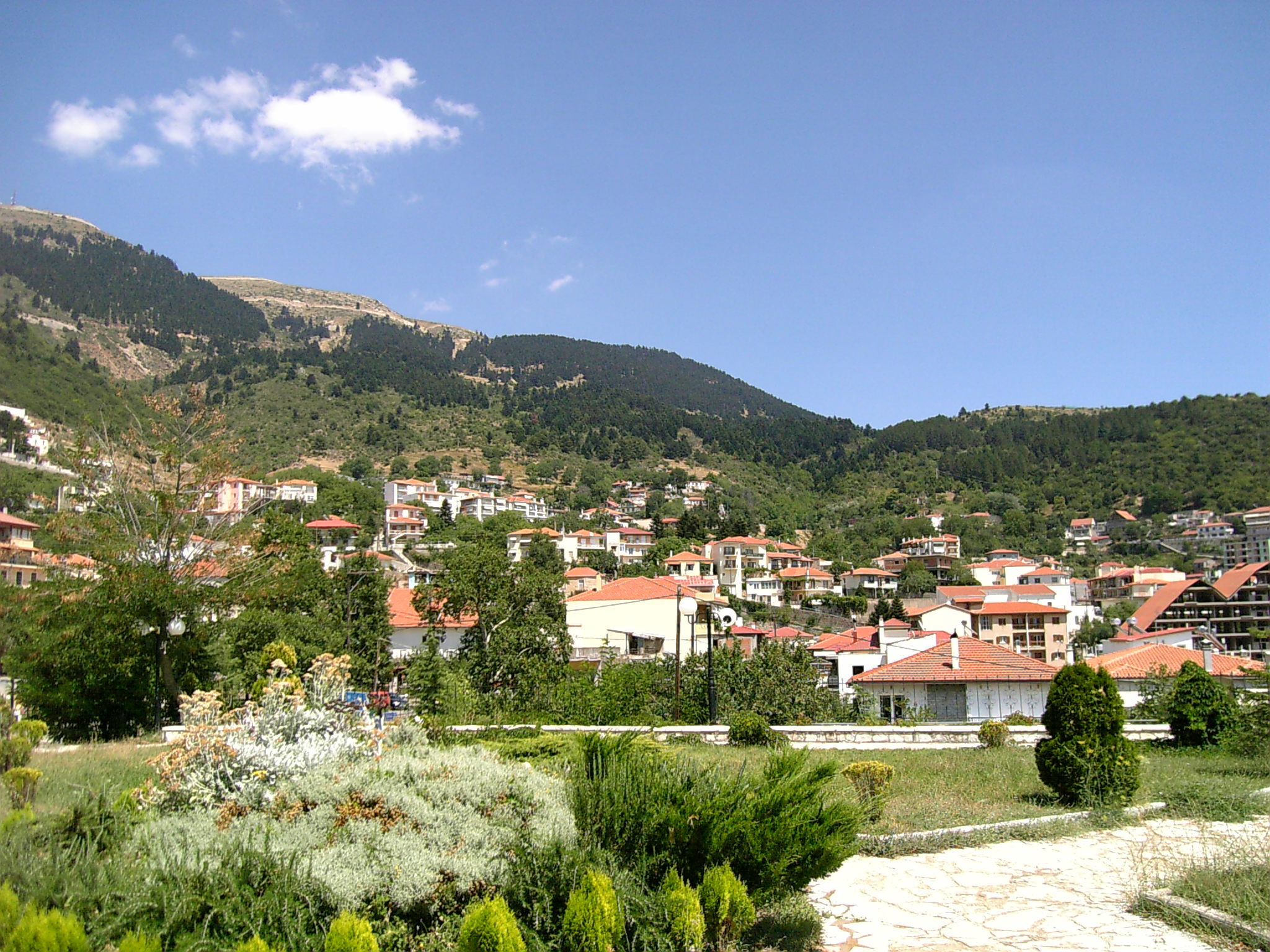
When I traveled to Greece a few years ago, I feel I experienced something of cosmopolitanism. During one evening in Karpenisi, Greece (a sister city to Asheville, for what's it worth), my cohorts and I were invited to a traditional Greek dinner with the assistant mayor, Papadopoulos (amazing Greek name), and various other citizens of the city. It didn't matter that we were American; at that table, we were all citizens of the world, dining together on Greek delicacies and living it up as if we were one in the same. 

Being in Greece the whole time as an outsider never seemed like a bad experience. People rejoiced over the election of Obama and yearned for a greater global community. When I was in Turkey as well, the people sought solidarity among the nation especially with the Turks being excluded from the European union and shunned by Greece.


Similarly, I like when Appiah writes, “a lot of what we take to be right or wrong is simply a matter of customs.”  We may judge the practices of another culture or group of people, but when we do so, we inevitably use our own values as a point of comparison. Should we give each culture a fair view, perceiving them not as wrong but simply different. I think not; that is what we call, as you may know, cultural relativism. I have a firm set of moral beliefs rooted in my faith, and I have no problem applying what I believe to the rest of the world’s practices, because I believe my faith is universal. I do believe activities like genocide or genital mutilation are wrong because my worldview is steeped in love, and I have no interest in perceiving other cultures as merely different. The whole idea of cultural relativism seems lazy.


This notion of cosmopolitanism causes me to think about my own Christian faith. I believe that we all do fall under a shared, single morality system, one originating from a single omnipotent God. As Paul writes in Galatians 3:28, “There is neither Jew nor Greek, there is neither slave nor free, there is no male and female, for you are all one in Christ Jesus.” With the person of Christ, all are reconciled and fall under equal justification in a way that seems even more logical and beautiful than cosmopolitanism can articulate. There is a lot of stigma associated with evangelical religions because the nature of proselytizing seems to indicate, “we’ll only love you if you become one of us.” I don’t see it that way at all; the whole message of Christ revolves around and love and unity, bringing all individuals unto the unfailing love of one God. Any fault in the approach is of the messengers and not the message.

Even in the apocalyptic prophecy of John in the Book of Revelation, we can find instances of international harmony. He writes, "After this I looked, and behold, a great multitude that no one could number, from every nation, from all tribes and peoples and languages, standing before the throne and before the Lamb, clothed in white robes, with palm branches in their hands, and crying out with a loud voice, “Salvation belongs to our God who sits on the throne, and to the Lamb!” (Rev 7:9-10). In the realm of Christian eschatology, in the end, all people will come together under a common cause, and that is the kind of end which I try to bring about in my daily interactions with people around me. Although I recognize the various differences in the people around me, their strengths as well as their shortcomings, I do not let that hinder the way I treat or try to love them. Where it counts, we are no different.


Regardless of whether you accept or adhere to another culture's beliefs, I think the real question is, "Can we all get along?"


Tuesday, January 31, 2012

Gross

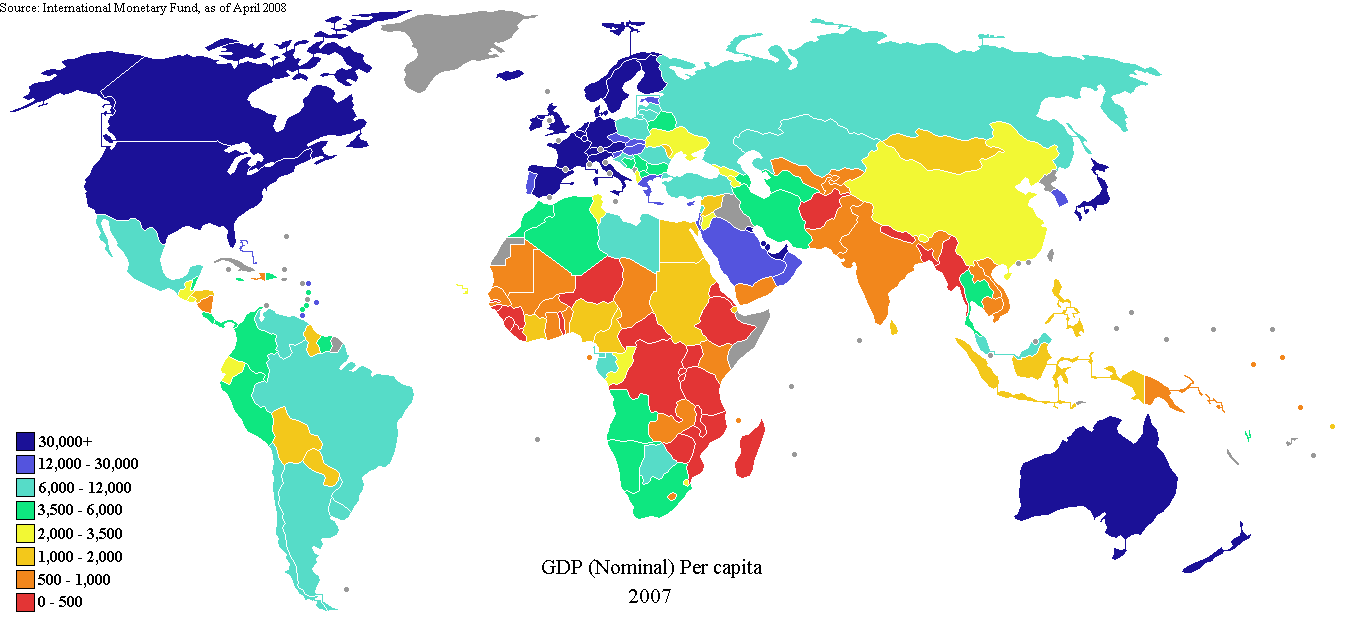
The Gross Domestic Product, a measure of all the values and goods for a country, and allegedly, a measure of its standard of living. The whole well-being of a nation is based upon a cold formula, .

Naturally, there are many reasons to object to such a indicator for a country’s quality of life as it omits important details and deals in generalizations. Martha Nussbaum set out to address the flaws in the GDP and proposes solutions in her book, Creating Capabilities.

One glaring flaw of the GDP as in indicator of a country’s standard of living is that it fails to address inequalities. It is merely an average, so although a country may have a high GDP and high quality of living for some of its citizens, a disproportionate amount may live significantly less securely. When I traveled to Turkey a few years ago, I witnessed this, especially in the megacity Istanbul. On the same street, you could find both dozens of lower class people crammed into a tiny apartment and a family and in a condo, sporting SUVs and other amenities of the higher class.
Yet these Range Rover-owning people drive up the GDP and paint an inaccurate picture of what the true quality of living is for most inhabitants.
  
         The GPD also fails to account for that important institution we’ve been talking about thus far, education. The obscure variables of the GDP formula -- private consumption, gross investment, government spending, exports, and imports – do nothing to shed light on a country’s quality of education. We’ve learned about the numerous problems in America’s education system, but you would never know it by only looking at America's GDP, for it is the highest in the world whereas countries cited to have education systems superior to the US such as Finland have a GDP 60 times smaller than that of the US. In even smaller states, like the Indian state of Kerala, a state with a small GDP, education flourishes. 

On a similar note, the GDP fails to account for the health of a nation. Because the GDP deals more with the goods and services of the country, it fails to account for the general well-being of its people. Life expectancy or prevalence of disease have little correlation to the GDP but are certainly reliable indicators for the quality of life in a nation. Take a country like China for instance. It has a high GDP and notable economic success but many other problems unseen in the GDP relating to public health such as the frequent outbreak of avian flu that grip the people cannot be seen from this one indicator. Monitoring more concrete and relevant statistics such as epidemics and outbreaks would paint a more accurate picture.

So Martha Nussbaum gives us what she calls the “Capabilities Approach.” Why use an obscure formula to measure something so organic, the value of human life? Surely all of our potentials and abilities cannot be realized through math but through a holistic view of our human lives. She writes that, “the real purpose of development is human development; other approaches and measures are at best a proxy for the development of human lives, and most don’t reflect human priorities in a rich, accurate, or nuanced way” (185). Nussbaum wants to look at what people can do and be since we are the true wealth of the nation (sorry Adam Smith). Profit then becomes an indicator of all that we have achieved, but it does not show the whole story, nay even the most important parts of the story.
Listen to her speak yourself here and here.

I too find it difficult to find my life included in an obscure statistic. I think about the kids at the I Have A Dream foundation who struggle with basic things such as locating their own state on a map or computing simple numbers and ideas. We can help these kids overcome academic struggles and help cross a bridge into the future. But none of this is reflected in the GDP. It really is gross.