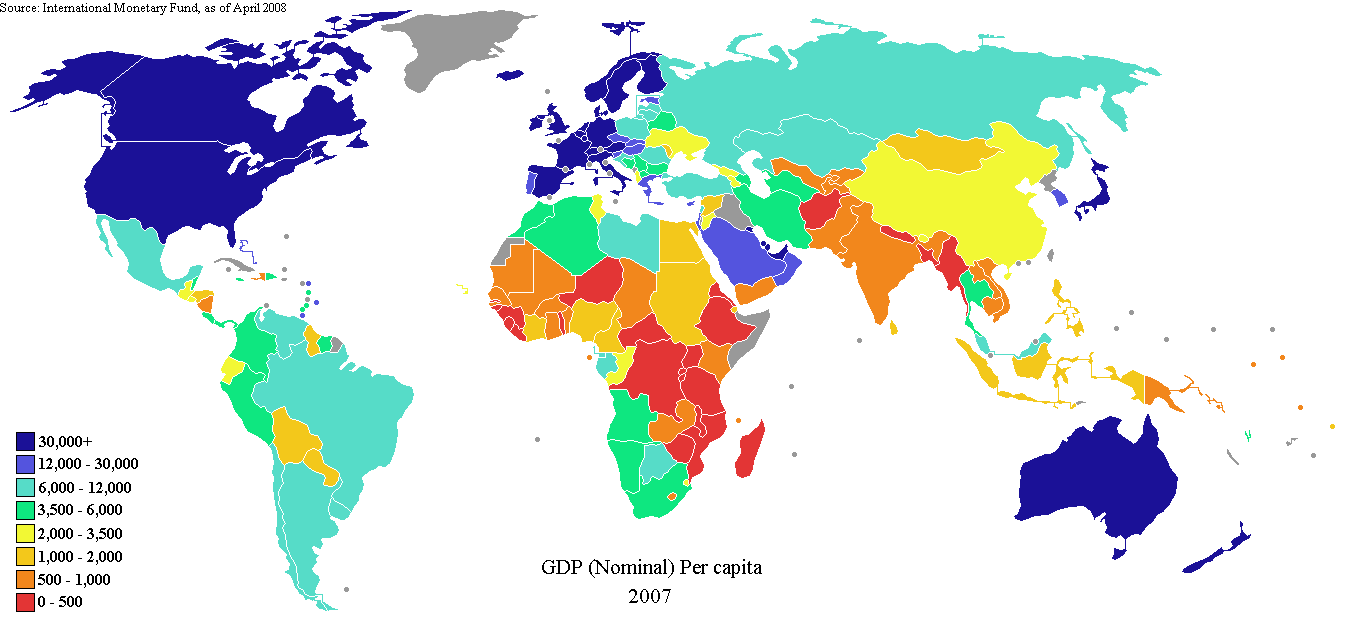
.
.Naturally, there are many reasons to object to such a indicator for a country’s quality of life as it omits important details and deals in generalizations. Martha Nussbaum set out to address the flaws in the GDP and proposes solutions in her book, Creating Capabilities.
One glaring flaw of the GDP as in indicator of a country’s standard of living is that it fails to address inequalities. It is merely an average, so although a country may have a high GDP and high quality of living for some of its citizens, a disproportionate amount may live significantly less securely. When I traveled to Turkey a few years ago, I witnessed this, especially in the megacity Istanbul. On the same street, you could find both dozens of lower class people crammed into a tiny apartment and a family and in a condo, sporting SUVs and other amenities of the higher class.
 Yet these Range Rover-owning people drive up the GDP and paint an inaccurate picture of what the true quality of living is for most inhabitants.
 The GPD also fails to account for that important institution we’ve been talking about thus far, education. The obscure variables of the GDP formula -- private consumption, gross investment, government spending, exports, and imports – do nothing to shed light on a country’s quality of education. We’ve learned about the numerous problems in America’s education system, but you would never know it by only looking at America's GDP, for it is the highest in the world whereas countries cited to have education systems superior to the US such as Finland have a GDP 60 times smaller than that of the US. In even smaller states, like the Indian state of Kerala, a state with a small GDP, education flourishes.
On a similar note, the GDP fails to account for the health of a nation. Because the GDP deals more with the goods and services of the country, it fails to account for the general well-being of its people. Life expectancy or prevalence of disease have little correlation to the GDP but are certainly reliable indicators for the quality of life in a nation. Take a country like China for instance. It has a high GDP and notable economic success but many other problems unseen in the GDP relating to public health such as the frequent outbreak of avian flu that grip the people cannot be seen from this one indicator. Monitoring more concrete and relevant statistics such as epidemics and outbreaks would paint a more accurate picture.
So Martha Nussbaum gives us what she calls the “Capabilities Approach.” Why use an obscure formula to measure something so organic, the value of human life? Surely all of our potentials and abilities cannot be realized through math but through a holistic view of our human lives. She writes that, “the real purpose of development is human development; other approaches and measures are at best a proxy for the development of human lives, and most don’t reflect human priorities in a rich, accurate, or nuanced way” (185). Nussbaum wants to look at what people can do and be since we are the true wealth of the nation (sorry Adam Smith). Profit then becomes an indicator of all that we have achieved, but it does not show the whole story, nay even the most important parts of the story.

I too find it difficult to find my life included in an obscure statistic. I think about the kids at the I Have A Dream foundation who struggle with basic things such as locating their own state on a map or computing simple numbers and ideas. We can help these kids overcome academic struggles and help cross a bridge into the future. But none of this is reflected in the GDP. It really is gross.